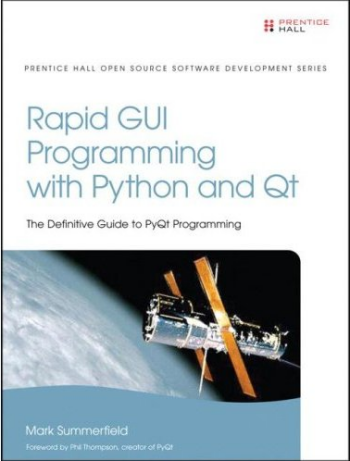
Rapid GUI Programming with Python and Qt
The Definitive Guide to PyQt
Programming
by Mark Summerfield
ISBN-10: 0132354187
– ISBN-13: 978-0132354189
A sample
chapter is available free from InformIT—click "Sample Content" and then "Download
the chapter" (almost at the bottom of the page).
This book teaches programmers how to write programs using PyQt 4,
the Python bindings for the Qt 4 application development framework.
PyQt 4 is probably the fastest and easiest route into GUI
programming and works on Windows, Mac OS X, and most operating
systems that use the X Window System, such as Linux and many
Unices. Note that the book is also useful for PySide
programmers. (Be aware that from PyQt4.6, PyQt now has two slightly
different APIs—but this only affects Python 3 out of the box
and doesn't affect Python 2 users unless they want it to.)
The book will be useful to people who program professionally as part of
their job, whether as full-time software developers, or those from other
disciplines, including scientists and
engineers, who need to do some programming in support of their work.
It is also suitable for students—the only prerequisite is basic
knowledge of an object oriented programming language, for example, Java
or C++, or of course Python itself.
The book is ~550 pages (648 including the appendices and index), has a
foreword by Phil Thompson creator of PyQt, and is
published by
Prentice
Hall. It can also be bought from other online and local book stores.
Only the printed editions are definitive—although available in
electronic formats, "ebooks" usually restrict your rights, and they are
often retypeset which can introduce errors. A legal PDF version is
available from InformIT.
Translations are arranged by the publisher and their quality can vary
considerably.
Downloads
In view of the EU’s Cyber
Resilience Act and an abundance of caution, we have withdrawn all
our free software, including our book examples.
Table of Contents—the
chapters also have exercises and summaries
- Part I: Python Programming
- Chapter 1. Data Types and Data Structures
- Chapter 2. Control Structures
- Chapter 3. Classes and Modules
- Part II: Basic GUI Programming
- Chapter 4. Introduction to GUI Programming
- Chapter 5. Dialogs
- Chapter 6. Main Windows
- Chapter 7. Using Qt Designer
- Chapter 8. Custom File Formats
- Part III: Intermediate GUI Programming
- Chapter 9. Layouts and Multiple Documents
- Chapter 10. Events, the Clipboard, and Drag & Drop
- Chapter 11. Custom Widgets
- Chapter 12. Graphics (this chapter is devoted to the graphics view
architecture introduced with Qt 4.2)
- Chapter 13. Rich Text
- Chapter 14. Model/View Programming
- Chapter 15. Databases
- Part IV: Advanced GUI Programming
- Chapter 16. Advanced Model/View Programming
- Chapter 17. Internationalization
- Chapter 18. Networking
- Chapter 19. Multithreading
- Appendix A: Installing Python, PyQt, and the Qt Libraries on
Windows, Mac OS X, and X11-based Unices including Linux
- Appendix B: Selected PyQt Widgets
- Appendix C: Selected PyQt Class Hierarchies
- Index
Part I is designed to quickly teach Python to non-Python programmers
so that they can use the rest of the book. This part is also useful to
Python programmers because it covers some of the non-GUI Qt classes, and
some of the Python techniques that are often used in GUI programming,
such as partial function application.
Most of the text is in Parts II, III, and IV. The chapters in these
parts cover similar ground to my C++/Qt
books, but have been written entirely from scratch with different
examples and written from a totally PyQt 4 perspective. Also, some
topics are included that are not covered by my other books, for example,
the rich text engine, and some more advanced model/view programming
techniques.
Unsolicited Reader Comments
- "This book is an absolute gold-mine, it's concise and practical
and shows examples which are applications in their own right, rather
than contrived ideas merely to illustrate a point."
- "First of all congratulations on the excellent book! Its been a
fantastic learning experience and I'm having a great time with the
material you present."
- "In contrast to many (most) IT-books I read, this book is a real pleasure to read."
-
"It's been a very long time since I enjoyed reading a technical book
this much... a brillant job for one of the most underestimated
technologies available today."
-
"Your book 'Rapid GUI Programming with Python and Qt' is outstanding!
I'm really enjoying it and PyQt is a pleasure to work with."
- "I am enjoying reading it and I am developing code at the same time."
- "The book is wonderful... PyQt's model seems to be a good fit for my brain so far.
Thank you for writing the book!"
- "I think that you managed to clearly get to the essence
of Python in very few words."
- "I decided not to rush and not to skip `what I already knew' and I am
learning some quite interesting things even from the initial chapters."
- "It's a very nice and comprehensive book..."
- "I recommend this book to anyone that wants to learn PyQt, it is
an excellent book..."
Reviews
To convert any particular example to PySide the steps are as follows:
These conversions are sufficient in most cases. However, a few of the
examples' behavior is not correct even after these changes. And
unfortunately, I don't have the time to investigate.
For more information on the tools the book teaches see the Python website, the Qt Software website (makers of Qt),
the Riverbank website
(makers of PyQt 4), and the PySide
website (makers of PySide, official Nokia-sponsored Python bindings
for Qt, largely PyQt compatible). And for those interested in scientific
and engineering programming the Python(x,y) Python distribution
should be of interest.
See also my Python Programming Tips.
Like all my books and most of my other writings, this book was written using The Lout
Typesetting System.
Your Privacy •
Copyright © 2006 Qtrac Ltd.
All Rights Reserved.
Top